The key objective of the SCCER-SoE in its Phase II is the initiation and in some case completion of demonstration projects in all areas of the our electricity supply portfolio. The new work package 5 is central to the strategy of implementing the integrated approaches developed for geo-energy (WP1) and hydropower (WP2) and the innovative technologies developed in WP3 in projects conducted with industry, which serve to demonstrate the feasibility of the proposed approaches.
The final objective of the innovation roadmap remains to develop by 2025 a portfolio of tested solutions to enable reaching the Energy Strategy 2050 supply targets.
|
The deep geothermal underground
laboratory (DUG Lab) project aims at
a better understanding of
hydro-seismo-mechanical coupled
processes that are associated with
high pressure fluid injections in a
crystalline rock mass. Experiments
are carried out at laboratory scale
(a few centimeters) and at
intermediate scale (a few tens of
meters). |
|
| Project Leader at SED | |
|---|---|
| Research Partners | ETHZ, NAGRA, UniNe |
| Funding Source | |
| Duration | |
| Keywords | |
| Research Field | |
| Link To Project Website | |
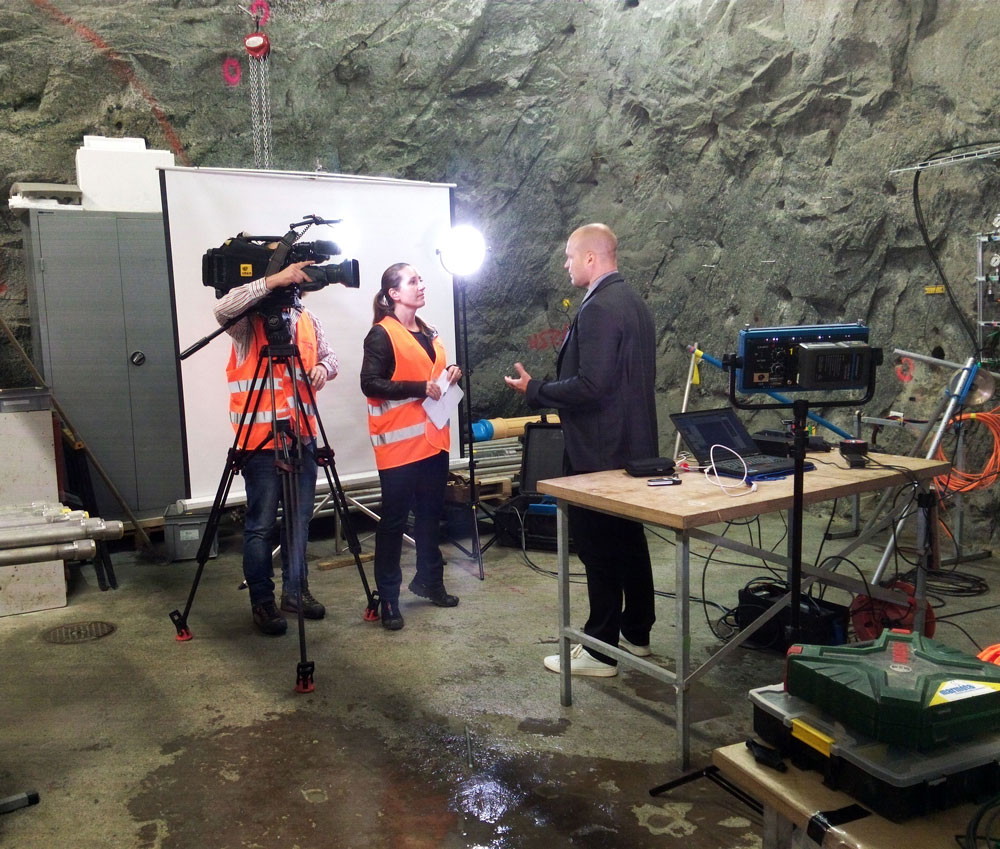
In September 2016, the SCCER-SoE invited journalists for a visit to the Grimsel rock laboratory to explore the experiment „In-Situ Stimulation and Circulation (ISC)“ led by Dr. Joseph Doetsch. Learn more about the journalists‘ impressions and the project in the following TV reports and newspaper articles:
|
GeoEnergie Suisse AG is developing a
pilot and demonstration project for
deep geothermal energy in the
village of Haute-Sorne (Jura).
Planned is a petrothermal deep
geothermal project reaching down to
4000 – 5000 m. The system is
projected to deliver up to 5 MWe
and/or heat for industrial processes
as well as district heating. The
total project costs are roughly 100
Mio CHF. For the first time, the
project will implement the so-called
multi-fracture system in a granitic
environment. Drilling is scheduled
to start in 2017 or 2018. |
|
| Project Leader at SED | |
|---|---|
| Research Partners |
GeoEnergie Suisse, ETHZ, UniNe |
| Funding Source | |
| Duration | |
| Keywords | |
| Research Field | |
| Link To Project Website | |
|
This demonstration project will be implemented as part of the “GEothermie-2020” program of the Canton of Geneva. A step-wise approach including drilling wells (production and storage) at progressively increasing depths (1500-2500 m) will be performed by SIG during Phase II (Q4 2016 – 2017). This will provide the opportunity to test and validate the effectiveness of exploration concepts and models developed within WP1 as well as proof the feasibility of direct heat production and subsurface storage potential in sedimentary basins at relatively shallow depths. The project is already approved and in advanced stage of realization. |
|
| Project Leader at SED | |
|---|---|
| Research Partners | UniGe, UniBe, SIG |
| Funding Source | |
| Duration | |
| Keywords | |
| Research Field | |
| Link To Project Website | |
|
According to IEA, IPCC and COP21, CCS has to be implemented to keep global warming within 2°C. After a long phase of experimentation on capture and sequestration technologies, efforts in Europe to implement a concrete strategy are growing, under the umbrella of the ECCSEL ESFRI infrastructure and the newly approved ERA-NET Cofund ACT. The Swiss plan is being developed by SCCER-SoE groups together with SFOE, BAFU and industry participation (on-going discussions with three possible industry partners). The plan aims (i) to use the ERANET-ACT support to expand the work already carried out in SCCER-SoE Phase I and previous national projects (CARMA) to ensure that the required science and technologies are available, and (ii) to realize a first pilot project in Switzerland to demonstrate at the field scale that CO2 storage can safely be done without causing unacceptable seismicity, fluid-mineral reactions and environmental contamination. The timescale of ERA-NET Cofund ACT is very favorable, with expectation of funding by 2017 (Swiss quota of 4 MFr for 4 years). We aim at initiating with SFOE a CO2 sequestration pilot by 2019. |
|
| Project Leader at SED | |
|---|---|
| Research Partners | ETHZ, EPFL, UniGe, UniGE |
| Funding Source | |
| Duration | |
| Keywords | |
| Research Field | |
|
A new small HP plant that will be installed/built in the coming 2 to 3 years will be selected to provide a comprehensive set of research carried out by SCCER SoE partners (and if possible SCCER Furies and SCCER Crest). Thanks to a concurrent approach, this demontrator will show the ability of a small hydropower station to produce clean, sustainable and renewable energy while producing ancillary services. Using the results from WP2 and WP3, several topics will be addressed such as: the now-casting and seasonal forecasts of discharge to the water intake as a basis for sediment management and for a flexible power production scheme; a critical review of the implemented operation practice, in view of efficiency improvements considering multi-sectorial objectives; a technical optimisation of the hydro electrical equipment operating conditions allowing a flexible control and set up of a predictive maintenance; investigation of the ecosystem functioning (metabolism, food web), fish migration and biodiversity; assessment of the new regulation for small hydropower plant and the possible financial models. |
|
| Project Leader at SED | |
|---|---|
| Research Partners |
HES-SO, all participants to WP2 |
| Funding Source | |
| Duration | |
| Keywords | |
| Research Field | |
|
Following the preliminary
implementation carried out in the
Mauvoisin reservoir in Valais, we
will implement a project with HP
industry with the goal of
demonstrating the effectiveness of
technologies to artificially stir
the water stored in a dam reservoir
to prevent sediment from settling
and allow for the sediment to be
conveyed downstream at acceptable
rates through the turbines. The
mobile mixing devise (demonstrator)
will be tested at several dams (1 to
3) to show its efficiency in
different conditions. |
|
| Project Leader at SED | |
|---|---|
| Research Partners |
EPFL, all participants to WP2 |
| Funding Source | |
| Duration | |
| Keywords | |
| Research Field | |
|
FLEXSTOR will test a set of
innovative tools for flexible
operation of storage hydropower
plants in changing environment and
market conditions at a complex
hydropower scheme. This demostrator
is motivated by the main hydropower
challenge in Switzerland, namely the
need for flexible operation
targeting premium remuneration
hours, for which comprehensive
methodologies for hydropower
upgrading projects are still
missing. |
|
| Project Leader at SED | |
|---|---|
| Research Partners |
EPFL-LMH, all participants to WP2 |
| Funding Source | |
| Duration | |
| Keywords | |
| Research Field | |
© SCCER-SoE 2019 | Contact | Imprint | Disclaimer | Data protection