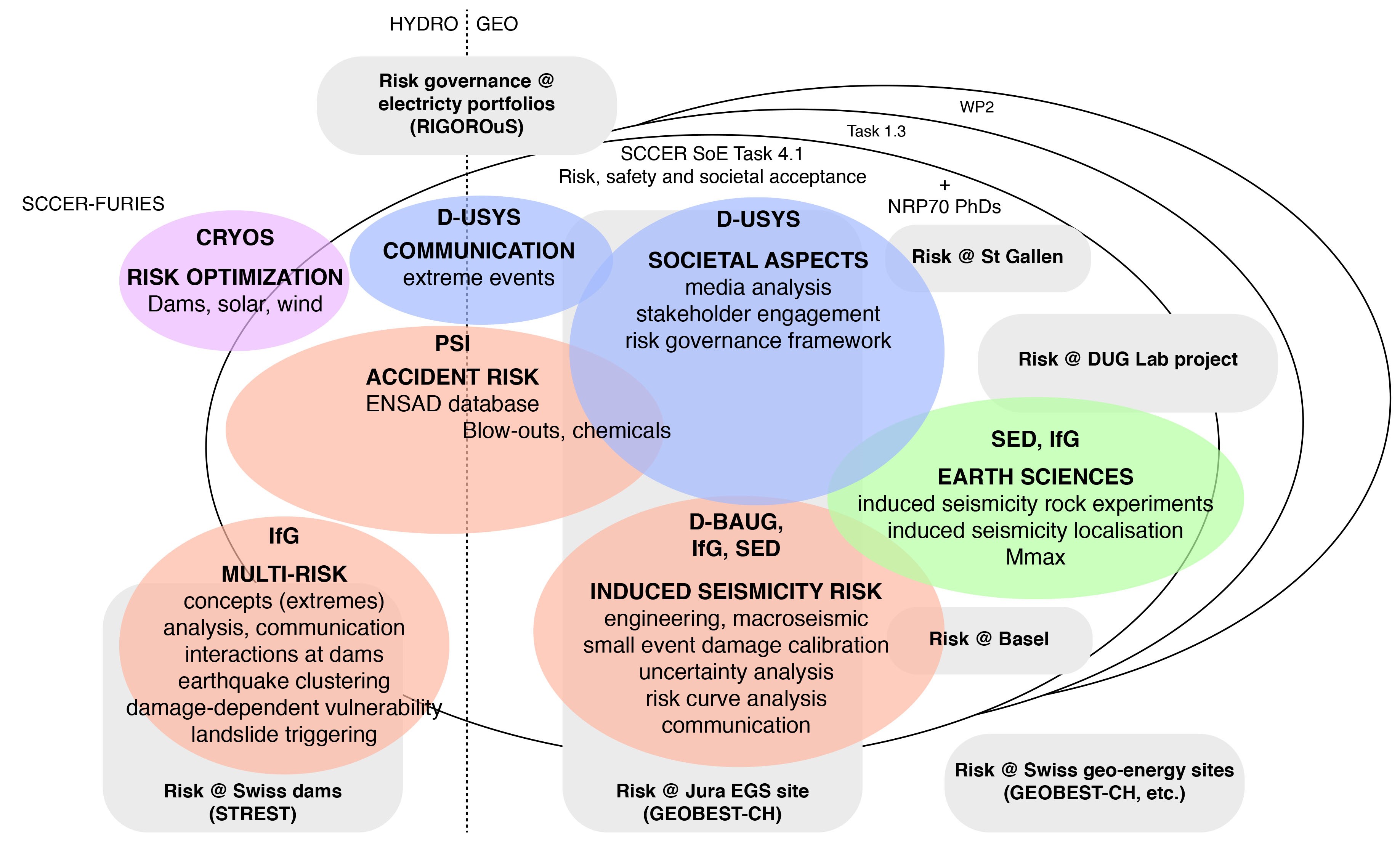
Any power generation technology has inherent risks. In order to allow for a safe and economic operation, those risks need to be managed throughout the lifecycle of a technology. The outcome of this task will be a rigorous common methodology and a consistent modelling approach to hazard, vulnerability, risk, resilience and societal acceptance assessment of energy technologies.
|
The SED aims to support the involved
authorities and industries in
establishing uniform quality
standards across cantonal borders
regarding earthquake-related issues,
approval procedures, and project
implementation. With this aim in
mind, the SED offers competent,
project-based seismological
consulting and monitoring services
through the GEOBEST-CH project
(successor of GEOBEST), supported by
SwissEnergy. |
|
| Project Leader at SED | |
|---|---|
| Funding Source | |
| Duration | May 2015 to August 2017 |
| Keywords | |
| Research Field | |
| Link To Project Website | |
|
Funded by the SNSF and NRP70, this project aims to develop a risk governance framework for geo- and hydro-energy by integrating risk assessment (in its various forms) and related risk perception models and tools. This should lead to a communication strategy for future energy-related projects. This project develops a holistic concept of risk governance from a truly multi-disciplinary perspective, advocating a broad picture of risk: not only does it include risk assessment and assessment of ability to recover, but it also looks at how risk perception and risk-related communication can be organized. Investigated risks are induced seismicity and accidents for deep geothermal projects and accidents for hydropower projects, with a focus on rare extreme events. |
|
| Project Leader at SED | |
|---|---|
| Funding Source | |
| Duration |
November 2014 to October 2017 |
| Keywords | |
| Research Field | |
| Link To Project Website | |
|
RT-RAMSIS is a joint CTI project
between the Swiss Seismological
Service SED and GeoEnergie Suisse
AG. It builds on research results
from previous joint research
projects GEOSIM and GEOBEST. We are
developing and validating a near
real time hazard and risk assessment
framework for induced seismicity in
geothermal projects. With fluid
injection rates and
micro-earthquakes recorded in near
real-time and prepared as input, the
framework uses statistical and
hybrid statistical-hydromechanical
models to forecast seismicity in six
hour intervals. Subsequent stages
then compute probabilistic seismic
hazard and risk estimates based on
different injection scenarios and
thereby help the operator to balance
risk and reservoir stimulation
efficiency. |
|
| Project Leader at SED | |
|---|---|
| Funding Source | |
| Duration | May 2015 to April 2018 |
| Keywords | |
| Research Field | |
|
The RIGOROuS project aims at examining cross-technology and spatial tradeoffs of multiple risks created by electricity portfolios in Switzerland. It focuses both on developing a new scientific approach to synthesizing risk knowledge and on enabling interactive knowledge exchange among scientists, stakeholders and the public. For this purpose, two interactive tools Riskmeters (basic and spatially-explicit versions) are being developed, tested and applied. These tools map out cross-technology and spatial risk tradeoffs of Swiss electricity portfolios. The portfolios are constructed using the electricity system model EXPANSE (EXploration of PAtterns in Near-optimal energy ScEnarios). Riskmeters are then used to measure public, stakeholder and expert preferences for the electricity portfolios in light of risk tradeoffs. |
|
| Project Leader at SED | |
|---|---|
| Funding Source | |
| Duration | July 2015 – June 2018 |
| Keywords | |
| Research Field | |
| Link To Project Website | |
|
This project is aimed at creating EGS reservoirs with sufficient permeability, fracture orientation and spacing for economic use of underground heat. The concepts are based on experience in previous projects, on scientific progress and developments in other fields, mainly the oil and gas sector. Recently developed stimulation methods will be adapted to geothermal needs, applied to new geothermal sites and prepared for the market uptake. Understanding of risks in each area (whether technological, in business processes, for particular business cases, or otherwise), risk ownership, and possible risk mitigation will be the scope of specific work packages. The DESTRESS concept takes into account the common and specific issues of different sites, representative for large parts of Europe, and will provide a generally applicable workflow for productivity enhancement measures. The main focus will be on stimulation treatments with minimized environmental hazard (“soft stimulation”), to enhance the reservoir in several geological settings covering granites, sandstones, and other rock types. It will include business cases including public debate. Industrial participation is particularly pronounced in DESTRESS, including large energy suppliers as well as SMEs in the process of developing their sites. |

|
| Project Leader at SED | |
|---|---|
| Funding Source | |
| Duration | 2016 – 2020 |
| Keywords | |
| Research Field | |
| Link To Project Website | |
|
Moving toward a safer and more resilient society requires improved and standardized tools for hazard and risk assessment of rare extreme events, and their systematic application to whole classes of critical infrastructures, targeting integrated risk mitigation strategies. Among the most important assessment tools are the stress tests, designed to test the vulnerability and resilience of individual critical infrastructures and infrastructure systems. Following the results of the stress tests recently performed by the European Commission for the European Nuclear Power Plants, it is urgent to carry out appropriate stress tests for all other classes of critical infrastructures, which is the research topic of the STREST project funded by the European Commission. Swiss dams are one of the infrastructures considered in STREST, based on collaboration between ETHZ IfG, ETHZ D-BAUG and EPFL. |
|
| Project Leader at SED | |
|---|---|
| Funding Source | |
| Duration |
October 2013 to September 2016 |
| Keywords | |
| Research Field | |
| Link To Project Website | |
|
The Swiss Seismological Service (SED) is implementing the GeoBest project on behalf of the SFOE to provide cantonal and federal authorities with guidelines on how to handle seismic hazard in the framework of the environmental risk assessment. Within GEOBEST, selected pilot projects in Switzerland are supported in the necessary seismic monitoring of natural and induced seismicity. GeoBest supports the pilot project in the first two years that are most critical with respect to the financial risk, by providing seismological instrumentation from the GeoBest instrument pool and partial financial support for the installation and operation of the seismic monitoring network. In return the pilot projects grant SED access to project data needed for seismic hazard assessment and the development of best practice guidelines. |
|
| Project Leader at SED | |
|---|---|
| Funding Source | |
| Duration |
October 2010 to December 2015 |
| Keywords | |
| Research Field | |
|
Switzerland is estimated to have an enormous potential for deep geothermal energy, capable of providing up to 30 % of the total electricity demand of Switzerland. Therefore, geothermal energy is expected to play a significant role for the long-term security of base load electricity supplies. In order to tap this potential in Switzerland and elsewhere, it is imperative to develop reliable methods and tools for the estimation of the seismic hazard of induced seismicity in real time. Project GEOSIM, funded by SFOE, develops the methods, algorithms and software tools that are required for the realization of industry pilot projects, planned from 2014 onwards. |
|
| Project Leader at SED | |
|---|---|
| Funding Source | |
| Duration |
August 2012 to March 2015 |
| Keywords | |
| Research Field | |
© SCCER-SoE 2019 | Contact | Imprint | Disclaimer | Data protection